In today’s technology-driven economy, companies face a critical challenge: how to hire AI developers who can design, build, and maintain sophisticated artificial intelligence systems that solve complex business problems. Whether your project involves machine learning, natural language processing, computer vision, or reinforcement learning, hiring the right AI talent is non-negotiable to achieve success.
This comprehensive guide is designed for hiring managers and recruiters tasked with sourcing and managing AI talent. It delivers actionable, operational advice on how to hire AI developers and build resilient, collaborative AI teams—covering both onsite and remote modalities—to meet increasingly ambitious AI project goals.
Defining the AI Developer Role: Clarity Is the First Step
Before you hire AI developers, one foundational step is to precisely define the role you need. AI development can encompass a broad range of specialties. Clarify your technical requirements, project scope, and expected contributions from the AI developer for hire.
Key Role Categories for AI Developers
1) Machine Learning Engineer
- Builds and deploys machine learning models into production.
- Works with data pipelines, model training, evaluation, and APIs.
- Focuses on scalability, performance, and reliability.
- Typical tools: Python, TensorFlow, PyTorch, Kubernetes
2) Deep Learning Engineer
- Specializes in neural networks and large-scale models.
- Works on computer vision, NLP, speech, and generative AI.
- Designs architectures like CNNs, Transformers, RNNs.
- Often involved in research-heavy or cutting-edge projects.
3) NLP Engineer (Natural Language Processing)
- Focuses on systems that understand and generate human language.
- Chatbots, search, summarization, translation, LLM applications.
- Works with text datasets, tokenization, embeddings, prompt design.
4) AI Research Engineer
- Bridges academic research and real-world products.
- Implements new algorithms from papers
- Runs experiments, benchmarks models, and improves methodologies
- Often collaborates with data scientists and research teams
5) MLOps / AI Infrastructure Engineer
- Ensures AI systems run smoothly in production.
- Handles model deployment, monitoring, versioning, CI/CD pipelines
- Builds data infrastructure and automation workflows
- Focuses on reliability, reproducibility, and scaling
Tip: Use precise job titles such as “Hire AI Developer — Machine Learning Engineer” to direct the right candidates to your listing.
Job Description Essentials
- Required education and experience in AI and software engineering disciplines.
- Core technical skills: Python, R, ML frameworks, distributed data processing (Spark, Hadoop), cloud AI services (AWS Sagemaker, Google AI Platform).
- Soft skills: collaboration, critical thinking, agile development experience, and communication.
- Clearly outline project goals, deliverables, and team structure.
Sourcing Top AI Talent: Strategies for Success
The market for AI developers is extremely competitive. Here’s how to expand your candidate pool to secure AI developers for hire.
1. Leverage AI-Focused Job Boards and Communities
- Communities: GitHub, Stack Overflow, Reddit AI/ML subreddits, and LinkedIn AI groups.
- AI-specific platforms: Angel.co, Kaggle Jobs, ai-jobs.net and of course, calyptus.co
2. Partner with Universities and Research Labs
Collaborate with institutions known for AI programs. Many emerging talents seek industry roles after completing thesis projects or internships.
3. Use Specialized Recruiters and Agencies
Employ recruiters with a track record in sourcing AI talent. Their domain knowledge helps identify passive candidates who might not actively apply.
4. Advertise Flexibly to Include Remote AI Developers
Remote work options widen your candidate pool globally. To hire remote AI developers effectively, emphasize your company’s remote workflows, tooling (e.g., Zoom, Slack, JIRA), and support mechanisms in the job ad.
Evaluating Candidates: Technical and Collaborative Skill Assessment
When you hire artificial intelligence developers, assessment criteria must extend beyond coding tests. AI development requires a synthesis of software engineering, mathematical understanding, and teamwork.
Technical Evaluation Components
- Coding Challenge: Focused on Python proficiency and algorithm implementation relevant to AI workflows.
- Problem-Solving Exercise: Real-world AI scenarios—data cleaning, feature engineering, or model tuning.
- System Design Interview: Assess candidate’s ability to architect scalable AI pipelines and integration with existing software systems.
- Portfolio Review: Examine candidate contributions to open-source AI projects, Kaggle competitions, or research publications.
Soft Skills Assessment
- Communication: Can the candidate explain complex AI concepts in simple terms?
- Collaboration: Experience working in cross-functional teams with product managers, data engineers, and DevOps.
- Adaptability: Familiarity with agile methodologies and iterative development cycles.
Remote Hiring Best Practices: Securing Talent Beyond Borders
To hire remote AI developers, implement robust infrastructure and processes to support remote work:
- Clear Communication: Use synchronous (Zoom calls) and asynchronous (Slack threads, Confluence notes) tools to maintain clarity.
- Structured Onboarding: Provide comprehensive documentation, onboarding sessions, and assign mentor
- Clear Communication: Use synchronous (Zoom calls) and asynchronous (Slack threads, Confluence notes) tools to maintain clarity
- Outcome-Driven Management: Set measurable objectives and encourage autonomy.
- Cultural Integration: Regular virtual social meetings and cross-team collaborations build inclusion.
Onboarding AI Developers: Accelerate Productivity from Day One
Successful onboarding increases retention of AI developer for hire significantly. Best practices include:
- Share project roadmaps, data access protocols, and security requirements early.
- Offer training on proprietary tools and internal best practices.
- Establish check-ins in the first 30-60 days to address blockers.
- Encourage participation in code reviews and sprint planning meetings quickly.
Building a Resilient, Collaborative AI Team
AI development thrives in teams that blend complementary skills and foster continuous learning:
- Diverse Expertise: Combine machine learning engineers with data scientists, domain experts, and software engineers.
- Cross-Functional Alignment: Integrate product management, DevOps, and user experience teams for holistic delivery.
- Continuous Skill Development: Support attendance to workshops, conferences, and online courses (e.g., Coursera, Udemy AI tracks).
- Psychological Safety: Encourage open discussions on failures and iterative improvements.
Customizable Hiring Template for AI Developers
Use this operational template to streamline your hiring process:
Job Description Snapshot
Title: AI Developer (Remote/Onsite)
Responsibilities:
- Develop and deploy AI models for [specific domain].
- Collaborate with engineering and product teams to integrate AI solutions.
- Maintain AI training pipelines and monitor model performance.
Qualifications:
- 3+ years in ML/AI development.
- Proficient in Python, TensorFlow/PyTorch, SQL.
- Experience working in agile teams.
Soft Skills: Excellent communication, problem-solving aptitude.
Interview Framework
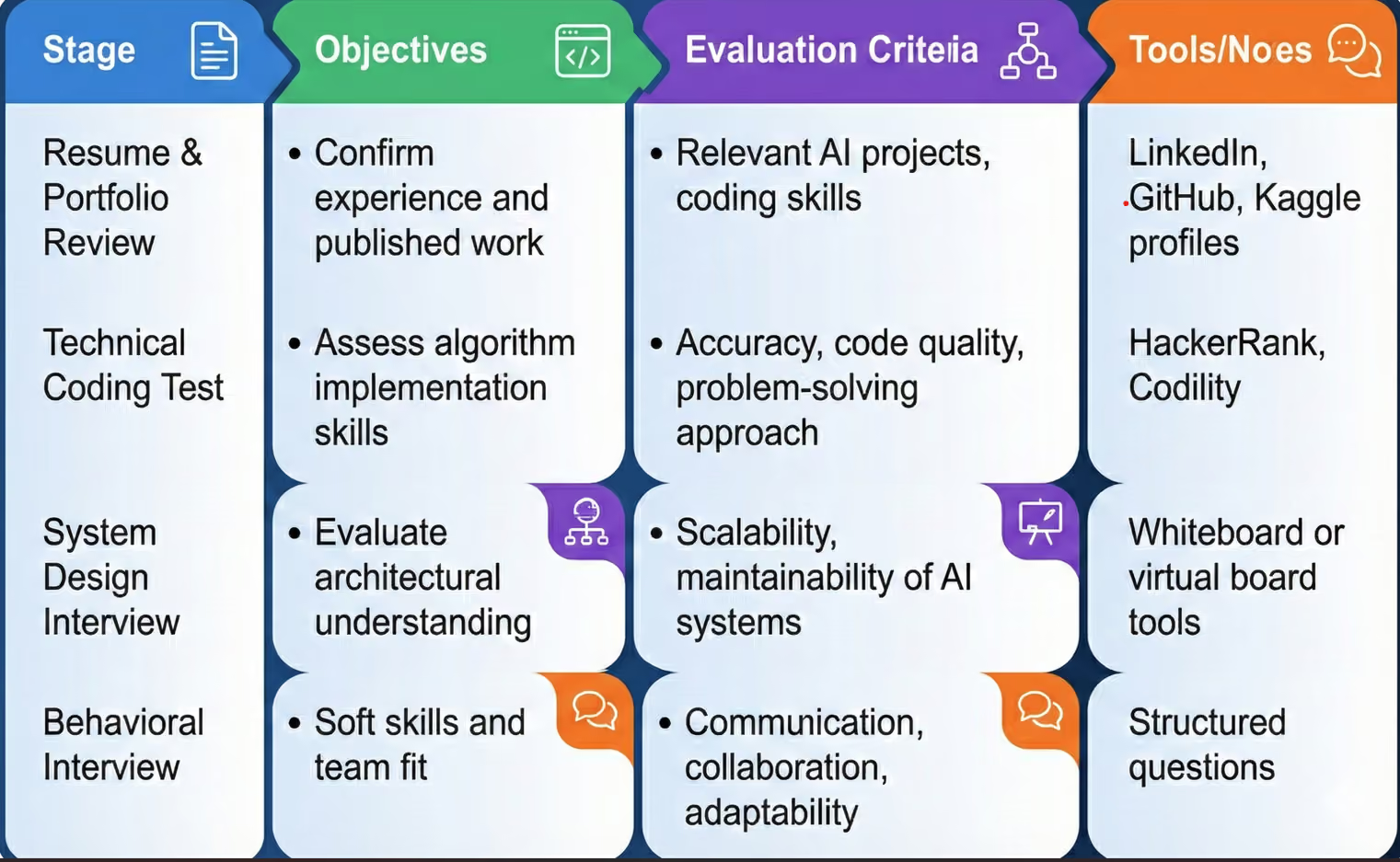
Candidate Evaluation Criteria
- Technical skills (1–5)
- Problem-solving (1–5)
- Collaboration & communication (1–5)
- Cultural fit (1–5)
- Overall recommendation
Conclusion
The complexity of building effective AI solutions demands a deliberate, stepwise approach to sourcing and hiring AI developers for hire. Clearly define roles, cast a wide net across specialized channels, rigorously evaluate both technical proficiency and soft skills, and implement tailored onboarding and remote work strategies. By doing so, you position your company to harness AI's transformative potential through a resilient, high-performing team.
Want a deeper understanding of AI/ML recruitment? Explore this detailed guide :
https://www.calyptus.co/blog/how-to-navigate-micro-shifts-in-hiring-ai-ml-developers