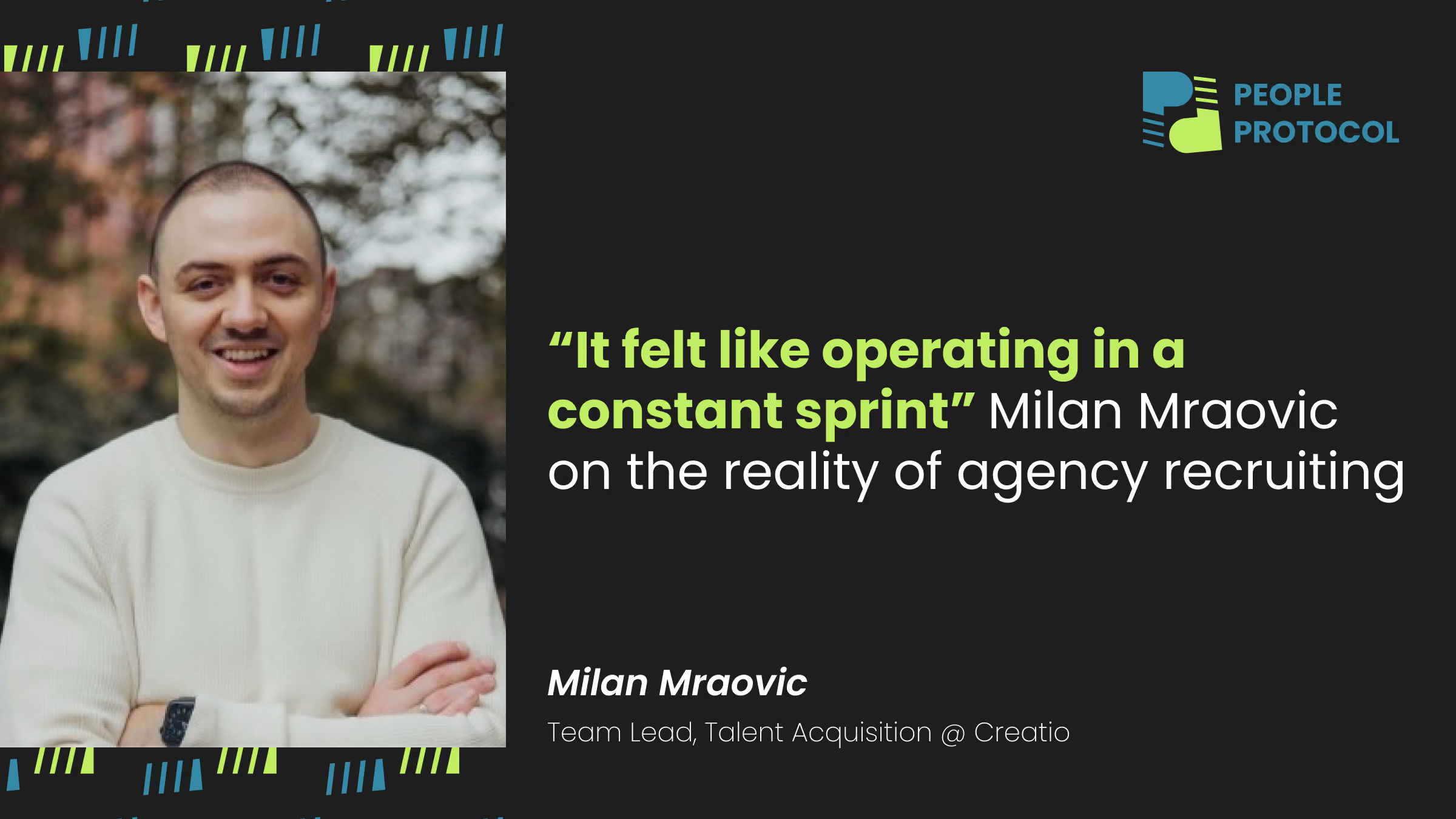
Milan Mraovic has built recruiting organisations across borders, time zones, and talent markets, moving from agency recruiting in Kyiv to leading GTM hiring across Europe and the Americas. Along the way, he has developed a clear point of view on what actually makes distributed talent teams work, and more about modern recruiting. In this conversation, Milan unpacks why local market expertise consistently beats proximity to headquarters, how the shift from agency to in-house recruiting changes your entire mindset, and what hiring managers still get wrong when assessing GTM talent.
Building a team & need AI-fluent talent? Calyptus supports 90+ Clients hire smarter, scale faster, and avoid growing pains. Head to the website (https://www.calyptus.co) to learn more.
You've built and managed distributed recruiting teams. What's the biggest misconception people have about leading remote talent acquisition teams at scale?
Remotely managed teams are expected to work with a higher level of ownership and accountability, therefore it is important that expectations, goals, and success metrics are clearly defined. This helped me to build a team that is not a showcase of the biggest misconception that managing remote teams is inherently harder and requires more micromanagement. In my experience, the opposite is true. I’ve found it significantly easier and more effective to work with recruiters who are based in the markets where we are hiring. The primary advantage is local market expertise, rather than having someone by my side in the office and needed to them to learn about the market and cultural differences from scratch. These recruiters are truly “on the ground”: they understand candidate expectations, compensation benchmarks, hiring competition, and cultural nuances far better than someone operating remotely from a different region. Just as importantly, they’re closely embedded with local hiring managers. That proximity builds stronger partnerships and enables recruiters to better understand the business context, team dynamics, and leadership style in each location. At scale, this local insight, combined with clear alignment at the global level, is what makes distributed talent acquisition teams not just manageable, but highly effective.
From agency recruiter in Kyiv to leading GTM hiring across Europe and the America. What surprised you most about the difference between agency and in-house recruiting?
While I didn’t spend a long time on the agency side, it always felt like operating in a constant sprint — moving quickly to deliver candidates, close requisitions, and keep the pipeline flowing. The focus was naturally short-term and transactional. Even when relationships mattered, there wasn’t always the time or context to build them deeply. When I transitioned in-house, I realised just how much of the role is about long-term relationship building and strategic talent planning. You’re not only hiring for the immediate need — you’re cultivating a network of high-calibre candidates who may not be ready to move today but could be a perfect fit in six months or a year. Staying connected, understanding their motivations, and proactively nurturing those relationships is ultimately what enables you to hire A-players consistently. It’s a very different mindset: less sprinting, more stewardship of the talent community around the organisation.
You've hired for GTM roles spanning Pre-Sales, Sales, and Post-Sales across wildly different markets. What traits actually predict success in these roles that hiring managers tend to overlook?
When it comes to Sales roles in particular — though this applies across GTM functions — hiring teams often miss two critical dimensions of a candidate’s fit:
- A structured evaluation of their knowledge, skills, characteristics, and execution experience. John McMahon captures this well in The Qualified Sales Leader: “If there’s no direct alignment between the required skills and knowledge of the candidate and your sales process, you’re taking a major risk. If you can’t cover their gaps with training and development, then hiring them becomes a complete risk.” Too often, teams assume past success will automatically translate into success in their environment. A more disciplined, competency-based assessment helps avoid these mismatches.
- A rigorous assessment of character. Traits such as intelligence, PHD (persistence, heart, desire), coachability, adaptability, integrity, and curiosity are incredibly strong predictors of long-term success — yet they’re frequently under-evaluated. Sometimes you should take a bet on character. If someone demonstrates the mindset and behaviours your team needs, the skills can be developed. For Account Executives especially, the interview itself should feel like a discovery call. The best candidates naturally handle objections, ask smart clarifying questions, and show how they think: “Why do you see it that way?” “What risk are you trying to mitigate?” “How can I help address that concern?” This isn’t just sales technique — it’s a real-time window into curiosity, intelligence, and whether they bring that PHD mindset to the role.
With AI reshaping how we source, assess, and engage candidates, what part of the recruiting process do you think will remain fundamentally human, and where is AI genuinely making your team more effective?
What must remain human is the final decision-making and the contextual judgement behind it. AI can support resume reviews or help assess technical submissions, but a human should always make the ultimate call. There are nuances in every career journey — personal circumstances, job changes, growth stories — that AI simply can’t interpret with empathy or accuracy. Where AI is genuinely valuable is in augmenting the process, not replacing it. Tools like Granola, Metaview, or Otter.ai are excellent for transcription, summarisation, and enhancing interview feedback. They help capture details that humans may miss in the moment, improving both fairness and quality of evaluation. AI is also becoming increasingly powerful in talent rediscovery — surfacing strong candidates already living in your ATS who may be a match for new roles. I expect this to be a major area of innovation in ATS product roadmaps over the next few years. If leveraged well, it will significantly reduce time-to-hire and help teams tap into talent they already worked hard to attract.
Hit subscribe and keep an eye out for next week’s edition. Thanks again to Milan Mraovic for taking the time to speak with me. For any projects currently hiring, check out what we do at Calyptus: https://www.calyptus.co