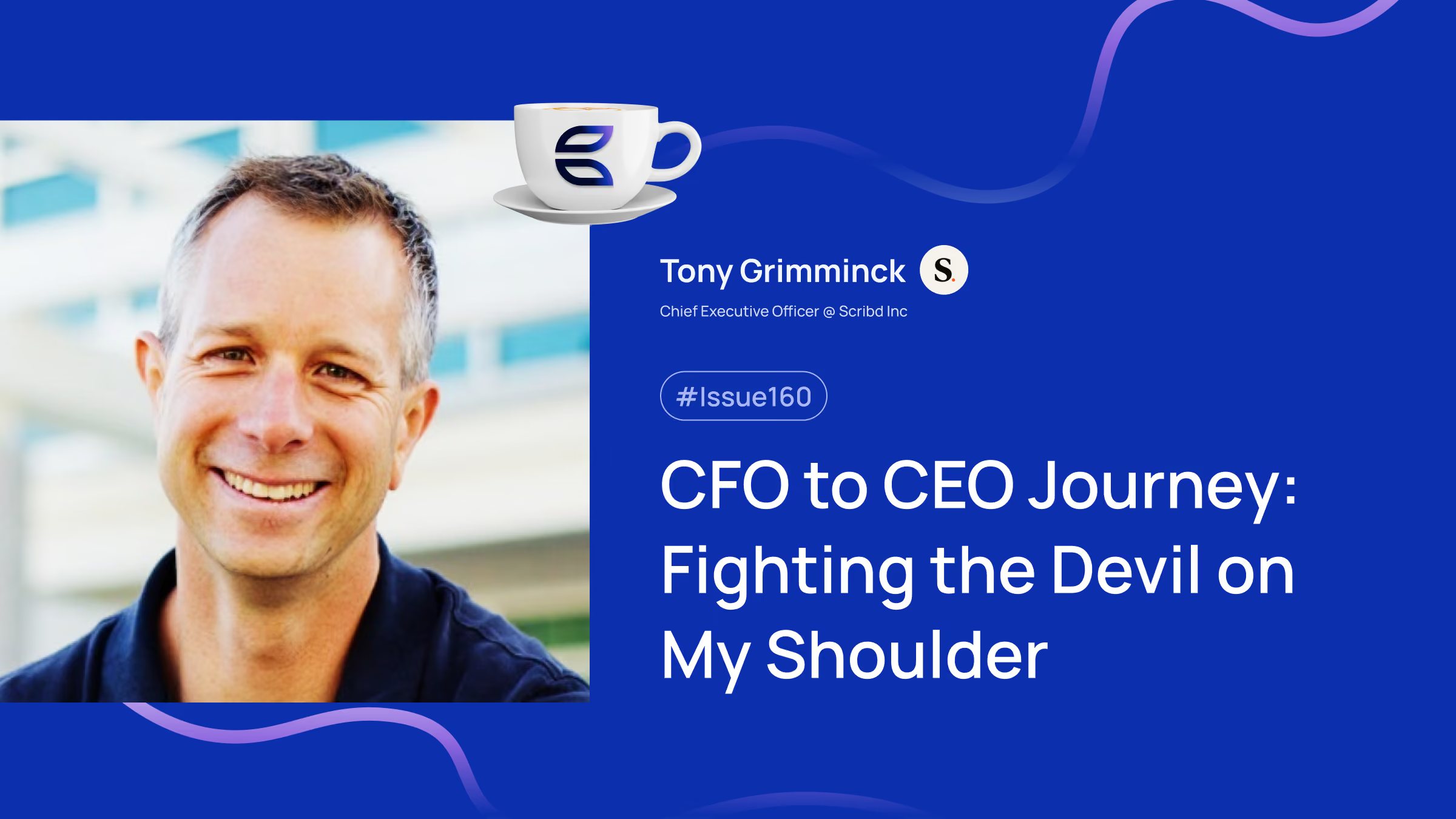
This week on Coffee with Calyptus, we sit down with Tony Grimminck, CEO of Scribd, Inc., whose career arc spans the Australian Army, Goldman Sachs, and Silicon Valley's tech landscape. Tony shares how building judgment across wildly different environments became the quiet throughline of an unconventional path to the top. From unlearning the CFO's "half-empty glass" mindset to making a counterintuitive bet against the AI doom narrative, his insights cut straight to the heart of what real leadership looks like. If you've ever wondered what happens when a soldier-turned-banker runs a content platform in the age of ChatGPT, this one's for you.
You've moved across some remarkably different worlds: the Australian Army, investment banking, operations, the CFO seat, and now the CEO chair. Was there a throughline you were consciously following, or did the path make sense only in hindsight?
When I look back, the path really only makes sense in hindsight. I grew up in a small country town in Australia, and joining the military was simply a way to get out and see the wider world. I didn't set out with a master plan to transition from peacekeeping to investment banking to tech leadership. However, there is a clear throughline that developed over time: building judgment. Whether I was in East Timor or Silicon Valley, I learned that talent comes from everywhere, and navigating different environments forces you to adapt, stay curious, and make difficult decisions. The wider your geographic and cultural exposure, the better your judgment ultimately becomes.
Going from CFO to CEO is a transition many finance leaders aspire to but few make. What did you have to unlearn, or actively fight against in yourself, when you stepped into the top role at Scribd in 2023?
I had to completely unlearn my "forensic analyst" mindset. As a CFO, you own the business model, you focus on driving efficiencies, and you are trained to constantly evaluate risks. Your glass is inherently half empty. But when I stepped into the CEO role, I realized I had to become more of a "fortune teller" who looks two to five years into the future, who creates the long-term vision for the company. I actively had to fight the devil on my shoulder telling me to worry about the condition of the tires and whether we'd run out of gas, because as CEO I have to be the unapologetic optimist who gets everyone on the bus and makes sure it's heading in the right direction.
How much of what you learned as an Army officer still shows up in how you lead a tech company today, and where does that model break down?
In the military, you operate in an unforgiving environment where mistakes can have fatal consequences. The most important lesson I brought into the corporate world is how to balance achieving the immediate mission while protecting the people who need to get you to the next one. You can't burn out your team to hit today's target, because you'll arrive at the next challenge broken. But it's your call and responsibility to decide how hard to drive the team. So, as the leader, the buck stops with you. You can't pass on the hard, unpopular calls to someone else.
Where the military model breaks down in tech is the rigid hierarchy. There is no shining of boots or ironing uniforms here. In an environment where technology changes daily, I look for strong opinions that are loosely held. I actively want my team to challenge me, disagree with me, and fight the CEO echo chamber so we can uncover the best ideas, which isn't exactly how the military operates.
Building and scaling companies rarely goes in a straight line. What's a moment or a bet that didn't go the way you expected, and what did it change about how you operate?
When ChatGPT launched, there was a narrative that it was an existential threat that would kill content platforms. At the time, we had a confusing customer experience. A "hairball of content" running an unlimited subscription model. We knew we had to make a change, so we made a counterintuitive bet: we unbundled into three distinct brands, acquired a fourth, and ended the unlimited model in favor of a credit-based system to force intentional choice.
The transition wasn't frictionless. But it forced something valuable — a sharper focus on the user experience for each product independently. And the early signal that stands out most is Scribd.com itself, where we've seen a surge in traffic as people didn't stop looking for trusted, human-created content. It confirmed something we believed but needed the market to prove: when AI gives everyone the exact same homogenized answers, authentic original knowledge becomes exponentially more valuable. Limitations, it turns out, create cognitive value. That's the bet we're still building on.
How is your team actually integrating AI into the day-to-day work of running those products, and where are you still figuring it out?
We don't view AI as a replacement for human thought; we view it as a tool for amplification and discovery. Across our products, we're using it to power personalized content discovery at scale, translate documents across languages to open our corpus to global audiences, and enrich metadata to make content more discoverable. With over half a billion pieces of content, recent developments in AI technology have allowed us to better understand, summarize, and serve this content to our audience. It's also allowed us to create innovative experiences on top of that content.
Where we are still figuring things out is how to get knowledge off the screen and actually into the human brain. On Scribd.com, AI can summarize multiple 50-page documents instantly and synthesize them into a coherent summary. But we need to work on the pedagogy — how to build the structured explanations, visual summaries, and study tools that bridge the gap between silicon and carbon. We want to build deep human understanding, not just outsource our thinking to an algorithm.