Hiring backend engineers is a critical task for any organization building scalable, reliable applications. Yet in highly competitive technical talent markets, it’s often challenging for employers to objectively evaluate and select the right backend developer for hire. Without a structured approach, hiring managers risk inconsistent assessments, unconscious bias, and inefficient processes that slow down recruitment or lead to poor hiring decisions.
This operator playbook will guide you through using scorecards to streamline your hiring process and confidently hire dedicated backend developers who match your technical needs and team culture. You’ll gain practical steps and a detailed, ready-to-use scorecard template so you can assess candidates consistently, transparently, and effectively.
The challenge of hiring backend developers
Backend engineers have deep responsibilities that range from database architecture and API development to server-side performance optimization and security. The nature of backend roles requires a combination of strong technical competence, problem-solving skills, and collaboration abilities.
However, when you interview backend developer candidates, you often end up with subjective impressions or inconsistent criteria that make it difficult to compare candidates fairly. This challenge is exacerbated as you try to hire backend engineers quickly in competitive markets where the best talent is in high demand.
Using a standardized evaluation tool tailored specifically for backend roles helps fix these issues.
What is a scorecard and why use one to hire backend developers
A scorecard is a structured rubric you create ahead of interviewing to assess each candidate against predefined criteria. It gives your hiring team an objective framework to evaluate core skills, cultural fit, and problem-solving ability relevant to backend development.
Benefits of employing scorecards to hire backend developer talent include:
- Consistency: Each candidate is evaluated against the same criteria with the same scoring scale, ensuring fairness.
- Transparency: Scorecards expose your hiring parameters clearly to all stakeholders, including candidates if you choose to share feedback.
- Reduced bias: Scorecards help minimize unconscious bias by focusing on data-driven assessments rather than gut feelings.
- Improved hiring outcomes: Organizations using scorecards report higher employee retention and job performance, according to data from the Harvard Business Review
- Faster decisions: With all candidates scored on a shared rubric, it becomes easier and quicker to identify top performers without endless deliberations.
A well-designed scorecard balances technical and soft skills to capture the full spectrum of what makes a backend engineer successful in your company culture.
How to create an effective scorecard for backend developers
To build a scorecard tailored for backend engineer hiring, follow these practical steps:
1. Define the core competencies
Identify the key areas the backend developer role requires. These usually include:
- Programming skills (e.g., proficiency in Java, Python, Go, or Node.js)
- Data structures and algorithms
- System design and architecture understanding
- Database knowledge (SQL & NoSQL)
- API design and integration
- Knowledge of backend frameworks or cloud infrastructure
- Testing and debugging proficiency
2. Incorporate soft skills and collaboration
Successful backend developers work closely with frontend teams, product managers, and QA engineers. Assess communication clarity, teamwork, debugging collaboration, and adaptability under pressure.
3. Establish a scoring scale
Decide on a consistent scoring rubric, often a numeric scale (e.g., 1 to 5) where:
- 5 = Exceptional mastery or demonstration
- 3 = Meets expectations or is proficient
- 1 = Below expectations or lacks experience
4. Weight criteria by importance
Consider weighting certain competencies more heavily depending on your current needs. For example, if you require cloud-native backend experience, that category can carry more weight.
5. Prepare behavioral and technical questions aligned to the scorecard
Create interview questions and coding exercises that map directly to each category. This ensures candidates are evaluated on experiences relevant to your backend stack.
6. Train your interviewers
Before using the scorecard, align your interview team on rating standards to reduce discrepancies between evaluators.
Sample scorecard template to hire backend developer talent
Below is a flexible template you can adopt or customize to your organization’s backend hiring process.
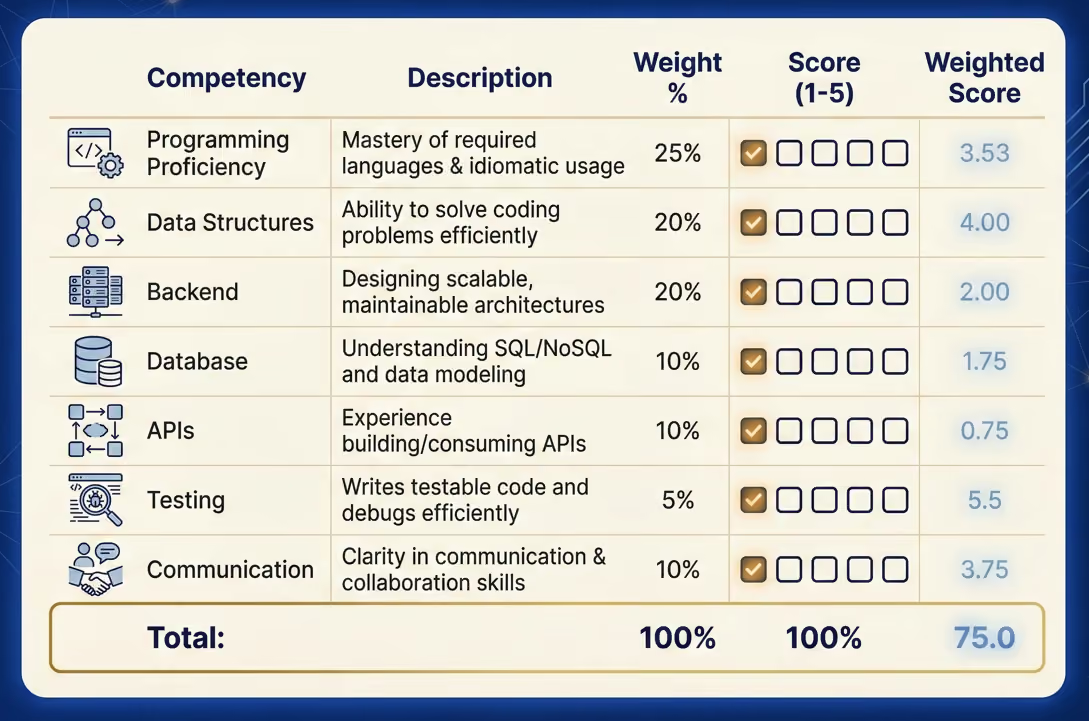
You can have interviewers fill out this scorecard after each round and then combine scores to get a consolidated ranking.
Applying scorecards to hire backend engineer candidates consistently
- Before the interview: Share the scorecard rubric with everyone involved in interviewing so they understand what to focus on.
- During the interview: Use technical exercises and behavioral questions mapped to the scorecard competencies.
- After each round: Have interviewers individually score candidates and then hold calibration sessions to discuss any major discrepancies.
- Decision making: Use the aggregated scores alongside qualitative feedback to select backend developer for hire that best matches your role requirements and team culture.
Conclusion: Scorecards make hiring backend developers smarter and faster
In competitive job markets, employers who want to hire backend engineers that perform and integrate well cannot rely on unstructured interviews or gut decisions alone. Using scorecards provides a repeatable, transparent, data-driven approach to evaluating backend developer candidates that balances technical skills with teamwork and communication.
Employers that leverage scorecards to hire dedicated backend developers reduce bias, improve interview consistency, and accelerate time to hire all while improving the ultimate quality of their backend engineering hires.
Adopt and customize scorecards within your hiring process today to confidently identify and attract the backend developer for hire who will power your applications and engineer your success.
Not sure how to evaluate real frontend potential? Explore our discovery-driven hiring guide how-discovery-driven-hiring-finds-frontend-talent-beyond-code