Mastering skills-based evaluation: a checklist to hire head of marketing. How can marketing leaders modernize their hiring practices to more precisely identify leadership talent beyond traditional resumes and credentials? Increasingly, companies seeking to hire head of marketing are turning to skills-based evaluation frameworks. This approach focuses on hands-on capabilities, strategic judgment, and leadership competencies rather than solely relying on tenure, education, or broad experience claims.
This operator’s playbook breaks down detailed, actionable steps to structure your hiring process around practical skills assessment at every stage. It’s designed for marketing decision-makers who want to confidently select candidates who bring measurable, high-impact marketing leadership to the table.
1. Define the critical skills for your marketing leadership role
Begin by mapping out the specific skills necessary for your marketing leadership position. This targeted alignment ensures every evaluation action tests relevant competencies.
- Identify role outcomes: e.g., revenue growth, brand positioning, digital transformation, team scaling.
- Define core hard skills: such as performance marketing, data analytics, content strategy, CRM tools.
- Identify leadership and soft skills: vision setting, cross-functional collaboration, people management, adaptability.
- Consult stakeholders: speak with executive leadership, existing marketing team members, and key business partners.
Pro tip: Use a skills matrix to prioritize must-have versus nice-to-have competencies.
2. Craft balanced interview questions centered on real-world skills
Typical interview questions often veer into abstract or theoretical territory. Replace these with practical, evidence-based queries that reveal candidate capability and working style.
- Behavioral questions: “Describe a marketing campaign you led that failed. What did you learn, and how did you pivot?”
- Scenario-based prompts: “How would you approach launching a product in an unfamiliar international market?”
- Technical problem-solving: “Walk me through optimizing a customer acquisition funnel with a fixed budget.”
- Leadership assessment: “How do you build consensus across sales, product, and creative teams when priorities clash?”
Balance question types across strategic thinking, quantitative skills, creative problem solving, and interpersonal dynamics.
3. Implement a structured evaluation framework for consistent scoring
To avoid bias and ensure objective comparisons, build a formalized framework for candidate evaluation focused on specific skill outcomes.
- Develop a rubric: On a 1–5 scale, score candidates against each prioritized skill (e.g., data-driven decision making, budget management).
- Use panel interviews: Multiple interviewers independently rate candidates, then calibrate scores collaboratively.
- Incorporate work sample tests: Request candidates complete short projects relevant to your marketing challenges.
- Weight scores appropriately: Combine interview and work sample results to form a composite evaluation.
Consistent scoring systems make final decisions transparent and demonstrably skills-focused.
4. Design practical work sample assessments aligned with your marketing priorities
Providing candidates with realistic assignments exposes their hands-on skills and problem-solving abilities in action.
- Examples include:
- Developing a 90-day marketing plan for a product launch.
- Analyzing campaign data and recommending optimization steps.
- Creating a mock pitch for a new market entry strategy.
- Set clear guidelines: Define deliverables, deadlines, and evaluation criteria upfront.
- Consider time investment: Keep tasks concise yet significant enough to reveal thoughtful strategy and execution skills.
Work samples bridge the gap between interviews and on-the-job performance, especially important when you hire marketing executive candidates, whose leadership decisions shape entire marketing operations.
5. Evaluate cultural fit and leadership style through structured conversations
Skills are paramount, but leadership roles demand alignment with organizational culture and values.
- Use values-based questions: “Tell us about a time you fostered an inclusive environment within your team.”
- Assess adaptability: “How do you adjust your leadership style when managing remote or hybrid teams?”
- Discuss vision and motivation: “What’s your philosophy on balancing innovation with marketing ROI?”
Complement skills metrics with qualitative insights to select leaders who can rally your teams and navigate change effectively.
6. Combine data and human insight for the final hiring decision
Synthesize quantitative scores, work sample results, and cultural fit observations into a documented decision-making process.
- Review rubrics and ratings alongside interview notes.
- Gather panel feedback in a debrief session to clarify differing perspectives.
- Rank candidates clearly against must-have skill thresholds.
- Record rationale for chosen candidate to ensure accountability and reproducibility.
This holistic approach prevents snap judgments and elevates hiring rigor.
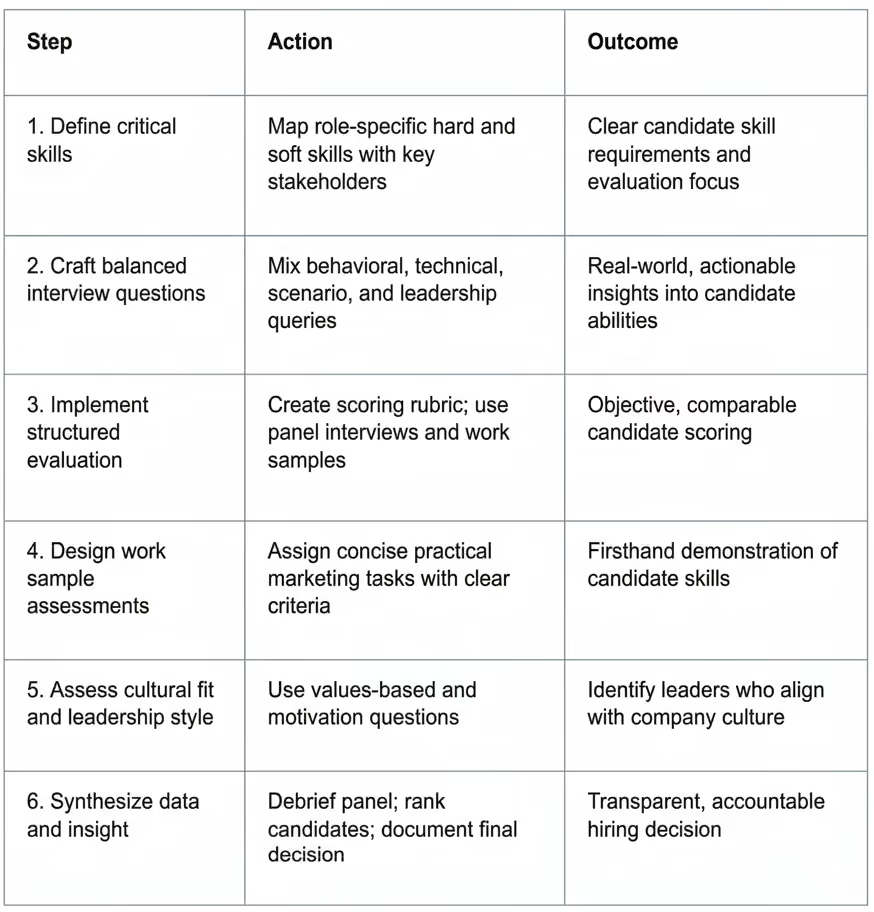
Quick checklist template for skills-based hiring of marketing leadership
Final thoughts: Embracing skills-based hiring to find marketing leaders who deliver
Transitioning from traditional resume-based evaluation to a skills-based framework creates tangible advantages. Candidates are assessed on real capabilities and leadership qualities that directly impact marketing performance. By following this checklist, organizations can reduce bias, increase hiring accuracy, and build stronger leadership teams.
When you decide to hire marketing executive talent, embedding skills-based evaluation will future-proof your marketing leadership pipeline and secure the strategic impact your business demands.