Are traditional hiring strategies for operations analysts meeting your evolving business needs this quarter? Many firms still rely on familiar talent pools or rigid recruitment frameworks, often overlooking the untapped potential, especially offshore.
When the pressure mounts to optimize operational efficiency and cost-effectiveness simultaneously, conventional wisdom might not cut it. Here, we explore contrarian yet practical approaches to hire operations analyst talent that can deliver measurable impact this quarter.
Rethink location as a strategic advantage, not merely a cost solution
The first hurdle in efforts to hire an operations analyst offshore is often an overemphasis on cost reduction. While lower wages are a factor, the more strategic benefit lies in accessing diverse skill sets and operational mindsets that can complement your existing teams. According to a 2023 Deloitte report, companies integrating offshore analysts into global teams have seen a 15% increase in process innovation compared to solely domestic hires (Deloitte, 2023).
Rather than limiting searches to traditional offshore hubs like India or the Philippines, explore emerging markets such as Colombia or Portugal, where talent pools often possess strong analytical capabilities coupled with improving business infrastructure. Hiring from these places can also mitigate cultural and time zone barriers that sometimes plague cross-border collaborations.
Leverage asynchronous coordination instead of forcing real-time alignment
One common misstep when businesses hire business operations analyst roles offshore is insisting on real-time communication, forcing cultural and scheduling strain. Instead, design workflows to maximize asynchronous collaboration. Tools such as Loom, Slack, and Notion allow for detailed briefing, private documentation, and ongoing feedback loops without imposing synchronous hours.
This method has particular merit in operations analysis, where much of the data crunching and process documentation can occur independently. A 2022 McKinsey study noted that teams using asynchronous workflows reduced project delays by 22%, especially in multiregional environments (McKinsey, 2022).
Enable offshore analysts to act autonomously through clear guardrails
Another contrarian insight is to trust offshore operations analysts with decision-making authority earlier in their tenure. Many firms err by relegating them to purely execution-level tasks, which underutilizes their potential. Onboarding structured around clear guardrails, defining scope, objectives, and escalation protocols , yet granting freedom within those boundaries drives ownership and creativity.
For example, an Australian retail chain hired an operations analyst offshore to redesign inventory management protocols. Rather than micro-managing, leadership provided KPIs and risk thresholds. The analyst independently designed and implemented a new forecasting model that decreased stockouts by 18% in under four months (Source: Case study shared by the client, 2023).
Customizing your candidate evaluation template for offshore hires
When you set out to hire an operations analyst offshore, standard interview templates focused on domestic markets may fail to reveal critical competencies. Here is a practical template adapted for this process:
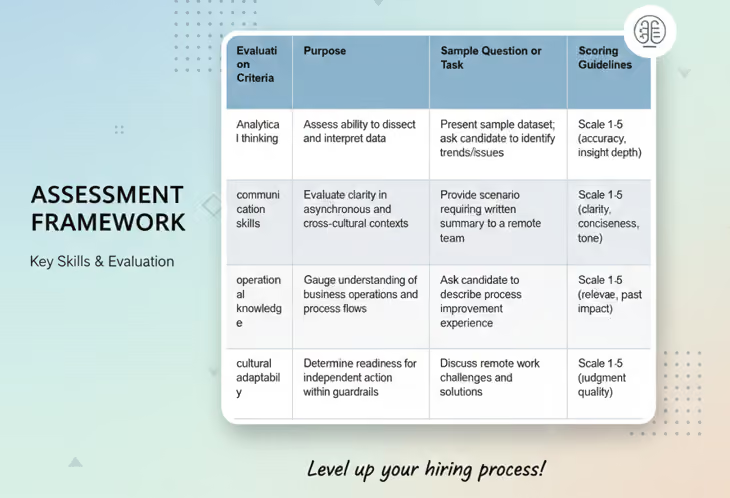
Use this template as a baseline and customize it to the specific operational domain of your business.
Adopting dynamic onboarding practices to accelerate impact
Once you hire operations analyst talent, onboarding becomes the next test. Rather than lengthy, heavily synchronous programs, opt for modular, bite-sized learning combined with project-based immersion. Digital platforms that provide asynchronous training videos, knowledge repositories, and mentors accessible across time zones accelerate ramp-up times.
A prominent engineering firm revamped its offshore business operations analyst onboarding in 2023, shifting to a self-directed curriculum supported by weekly virtual office hours. New hires were productive with minimal supervision within 30 days, compared to the prior 60-day average (Company internal data, 2023).
Balancing risk management with growth mindset
Many organizations hesitate to hire business operations analysts offshore due to perceived risks around quality or security. Rather than defaulting to risk aversion, a better approach is to embed robust governance, including auditing, compliance checks, and incremental responsibility increases, while adopting a mindset that treats offshore talent as long-term partners in growth
The global consulting firm Accenture, according to their 2023 Future Workforce Report, reduced attrition and increased offshore employee engagement by 30% after instituting joint accountability frameworks and clear career pathways (Accenture, 2023).
Conclusion
This quarter, the imperative to stay agile demands rethinking how you hire offshore operations analyst resources. Moving beyond stereotypes about cost and communication, businesses that embrace strategic location choices, asynchronous collaboration, autonomous roles, customized evaluation, and dynamic onboarding will unlock new operational advantages. By applying these unconventional tactics, hiring an operations analyst offshore transforms from a risk into a revenue-enhancing opportunity.
Want insights into modern product management roles? Check out our detailed resource at https://www.calyptus.co/blog/how-product-managers-roles-are-evolving
References
- Deloitte. (2023). Global talent trends and innovations report. Deloitte Insights.
- McKinsey & Company. (2022). Collaborate everywhere: Async work strategies for global teams.
- Accenture. (2023). Future workforce report: Elevating offshore talent engagement.
- Internal case studies and client reports shared in confidence throughout 2023.